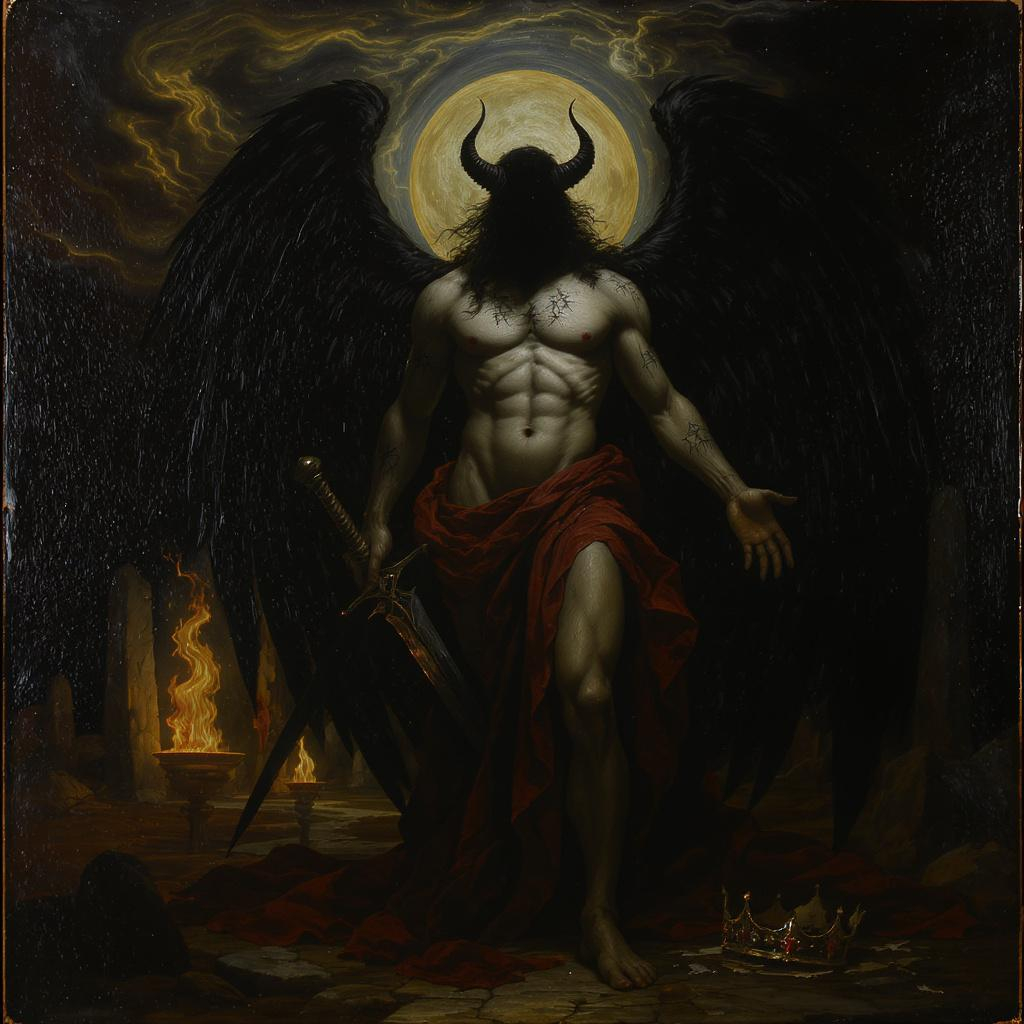
Origins in the Ancient World
Long before the name was darkened by theology, Lucifer was a god of light. In the Roman world he was Lucifer, the morning star, the herald of dawn who announced the coming of the sun. Poets invoked him not as a fiend but as a radiant deity. Cicero wrote of him as the star “which they call Lucifer, that heralds the day.”¹ Ovid, too, speaks of the morning star’s role as the shepherd of night, the one whose rising drives the stars away.² This was no adversary of heaven, but heaven’s own forerunner.
The Hebrew scriptures speak of Helel ben Shachar, the “shining one, son of the dawn,” whose fall from the heavens was a poetic taunt against the king of Babylon.³ Centuries later, St. Jerome translated this passage in the Vulgate Bible and chose the Latin name Lucifer. In that act of translation, the Roman god of morning light was drawn into the Christian imagination. Slowly, across sermons and commentaries, the bright herald became entangled with the image of the fallen angel, and what was once a star of hope was recast as a symbol of rebellion and ruin.
Would that not be the essence of the god Lucifer manifesting itself in its many faces and incarnations? As monotheism rose, the luminous herald was transfigured into the defier and initiator, revealing precisely the source of power where he was demonized.
Demonization and the Shadow of the Grimoires
With the passing of centuries, the name Lucifer became increasingly weighted with fear. Medieval preachers fastened upon Jerome’s choice of word, binding it to the legend of the rebellious angel who had fallen from heaven. What was once a star of promise was turned into the archetype of disobedience, a figure cast down for pride. Yet even here, a paradox abides. The very qualities for which Lucifer was condemned—light, beauty, knowledge, the refusal to bow—are those which also marked him as divine.
In the Grimorium Verum (c. 18th century), Lucifer’s role is more than symbolic. The text instructs the operator to address him first, before any subordinate spirit, for no working of the book can proceed without his leave.⁴ The Goetic grimoires reveal a world where no spirit can be moved unless a certain hierarchy between the spirits is acknowledged. Though couched in Christianized language of command and threat, the elaborate conjurations, the offerings of incense, and the triple repetition of his name all reveal an undertone of reverence. His presence is not easily won, but deeply respected.
Lucifer’s shadow is mirrored in Lucifuge Rofocale, his minister and steward. His very name, Lucifuge, “he who flees the light,” stands in paradoxical counterpoint to his master, the bearer of light. The Grimorium Verum describes him as the one who governs wealth and the treasures of the earth, a figure to whom pacts are made and by whose mediation the magician gains access to hidden powers.⁵ Collin de Plancy’s Dictionnaire Infernal likewise portrays him as the treasurer of Hell, guardian of secrets both perilous and alluring.⁶ In this we glimpse not only the Christian demonization of the light-bringer but also the persistence of his role as initiator into forbidden knowledge.
It may be said that Lucifer was not merely burdened with daemonic associations but has embraced them, or perhaps always carried them as part of his hidden nature. His countless Faces of flame and abyss are the keys to His mysteries. In heretical witchcraft this inheritance is reclaimed, the status quo of rigid dogma is overturned, and the very figures demonized by theology are restored as powers of initiation.
To defy the Demiurge — the false god — in this context, is not rebellion for its own sake. It is the refusal to let the spirit be chained to a design that denies its inner fire. Ascent is not flight into a far-off heaven and delusions of self-deification, but the rising of one’s own divine essence until it joins the great witch-fire He carries. Those who follow Lucifer learn to see the masks of divinity for what they are and to speak with the powers behind them without fear. Some meet him at the crossroad in the form of the Horned One, others as the bright angel, others as the Devil/Satan. However he comes, the work is the same. He calls the witch to awaken, to tend the inner sovereignty, and to walk unafraid between His many Blessings and Curses…
Modes of Approach in Sorcery and Witchcraft
Outside the ritual cloisters of scholastic grimoires, in the living streams of witchcraft, Lucifer appears not as a fiend to be bound but as a patron to be honored. In Charles Leland’s controversial but enduring Aradia, or the Gospel of the Witches (1899), he emerges as consort of Diana and father of Aradia, the luminous rebel and Witch-Father who gifts witchcraft to the oppressed: *“Diana greatly loved her brother Lucifer, the god of the Sun and of the Moon, the god of Light, who was so proud of his beauty, and who for his pride was driven from Paradise.”*⁷ In this guise he is not the adversary of creation but its liberator, the one who passes to mortals the forbidden fire of magic and knowledge. Though Leland’s text has been much debated, it preserves an image of Lucifer as initiator, the bright power who stands with the outcast against the law of Church and crown.
In the Grimorium Verum all paths lead first to Lucifer. No conjuration can move without his leave, for his name seals the threshold and opens the way.⁸ He is not counted among the lesser host but presides above them, sovereign and unseen, the silent arbiter whose presence makes all other traffic with spirits possible. To utter his name is to feel the air itself shift, for the pact is not ink upon parchment but fire written upon the soul. Fear and reverence walk hand in hand at this crossing, for he cannot be compelled or bound…
This primacy persists into the Lemegeton or Goetia, where although Lucifer is not numbered among the seventy-two daemonic spirits, his authority presides as sovereign and judge over the whole hierarchy.⁹ To call upon him is not ornament but necessity, for his presence licenses all other congress. Here the magician stands in the balance of dread and devotion, recognizing a power too great to be constrained by conjuration alone!
Yet the line from these old books threads forward into the practice of witches today. For them, Lucifer is not a cipher of command but the Morning and the Evening Star, the double light of descent and ascent. He awakens the witch-fire, the secret flame by which the hidden world is seen, the same fire that discloses the divine within the witch. To call him may be as simple as the lighting of a single candle in the stillness, or as elaborate as invocations beneath the hours of Venus, hymned with storax and wine. However it is done, each act is a return to that primal moment of recognition. In his name, the pact is renewed, not as tyranny but as teaching. The witch does not bind Him, but learns to walk beside Him.
Even within Goetic currents today, most magicians I know interpret Lucifer not as a spirit to be compelled but as a powerful and multifaceted deity. Jake Stratton-Kent remarks that *“Lucifer stands less as a demon among demons than as the gatekeeper of their whole company.”*¹⁰ In this light, the Goetia itself becomes less a manual of domination than a map to encounter, a set of keys leading to the threshold where human and the ineffable meet.
Lucifer is never bound to a single mask. He moves through the grimoires as the crowned sovereign of spirits, in Tuscan vineyards as the consort who gifts the flame of rebellion, and at the witch’s altar as the whisper that calls the inner fire to wake. In every guise he is the same radiant herald, who descends as the morning star and rises again as the torch of night. His gift is the secret fire that burns behind every mask of godhead, the light that awakens its reflection in the soul of the Witch. In that answering blaze the path is illumined, and the covenant of light and shadow is eternally renewed.
Notes
- Cicero, De Natura Deorum, II.20.
- Ovid, Metamorphoses, II.114–117.
- Isaiah 14:12; cf. Jerome, Vulgate Bible.
- Grimorium Verum, ed. Joseph Peterson (Ibis Press, 2016), 23–25.
- Grimorium Verum, ed. Joseph Peterson (Ibis Press, 2016), 27–31.
- Collin de Plancy, Dictionnaire Infernal (Paris, 1863), s.v. “Lucifuge Rofocale.”
- Charles Leland, Aradia, or the Gospel of the Witches (1899), ch. I.
- Grimorium Verum, ed. Peterson, 23–25.
- Lemegeton, Clavicula Salomonis Regis, ed. Joseph Peterson (Weiser, 2001), 69–71.
- Jake Stratton-Kent, The True Grimoire (Scarlet Imprint, 2009), 47.
 Path of Dusk
Leave a comment